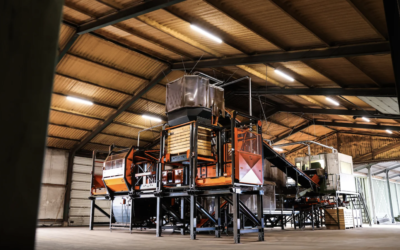

While sorting potatoes used to involve mostly dirty hands, these days, fine dust drifts through the air like a gray haze. Fully automated sorting releases it in large quantities. When purchasing a new sorting line, the Texel potato growing company De Lugt commissioned Jongejans Luchttechniek to design a complete dust solution that would put an end to the gray haze.
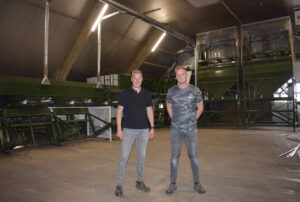
Last year, due to a staff shortage, De Lugt decided to invest in further mechanization. The De Lugt company is a true family business, dating back almost 100 years. Great-grandfather Cor de Lugt came to Texel from The Hague in 1928 to become a farmer and grew into a skilled and astute businessman. "He built a large warehouse capable of storing the produce of dozens of acres of potatoes, had the first weighbridge on the island, the first diesel oil tank, and was heavily involved in mechanization," say the fourth generation, nephews Matthijs and Bart de Lugt.
The company specialized in seed potato cultivation, among other things, where, in addition to disease-free cultivation, the efficiency of correctly sized potatoes is very important. In the early years, they developed sorting machines in-house. In 1983, the third generation of the company switched to the then-innovative mechanical sorting technology. By shaking the machine, the potatoes fall through the correct size. Because the product is dirty, this process releases large amounts of fine dust. After 34 years, De Lugt had become accustomed to this, but now that they are working with an optical sorter, the gray haze is a thing of the past.
These new investments were met with some skepticism from the third generation. "The mechanical sorting system still worked perfectly. My father didn't really see the need for innovation, but now he's wildly enthusiastic. He thinks it's unprecedented and is completely sold," says Matthijs. Although there's no shaking anymore, the fine dust generated during the transport of the potatoes through the sorting line poses some challenges for the optical system. Therefore, Jongejans Luchttechniek was brought in to handle dust and dirt capture at the various stages of the process and ensure optimal air quality in the warehouse.
Dust-free sorting process
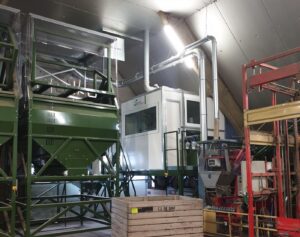
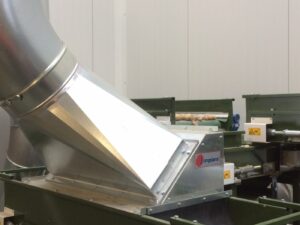
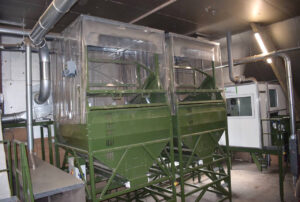
After harvesting, the potatoes are dried and stored refrigerated. When further processing is required, the crates are dumped into a bunker and conveyed via a conveyor belt to a hedgehog belt. This removes coarse dirt, straw, and clods. A lift belt then transports the potatoes to the distributor and then on to the optical sorter. Around this first section of the sorting line, Jongejans Luchttechniek encapsulated the bunkers and hedgehog belt to shield dust sources and prevent nuisance. Before the product enters the optical sorter, windshifting is used. This technology combines blowing and suction, resulting in an exceptionally clean product flow.
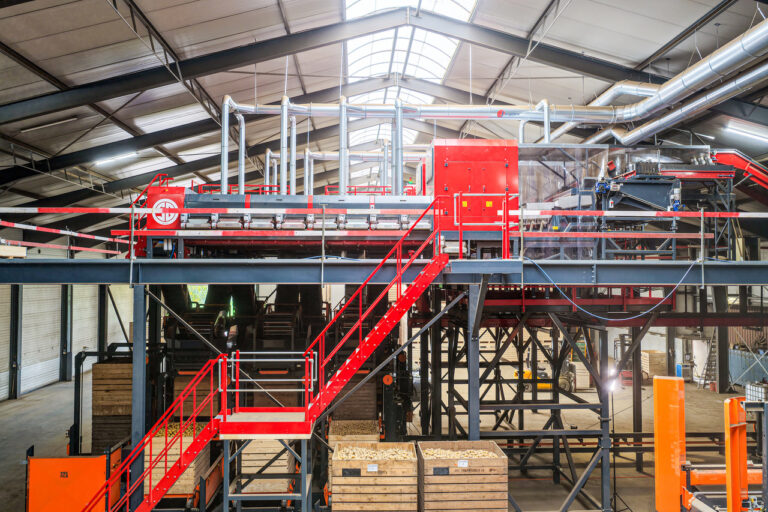
In the optical sorter, it's important that the air is clear to properly identify the potatoes. Good extraction is therefore crucial. After the potatoes pass through the camera section, an airflow blows them to the correct exit. The fine dust released during this process is removed by an extraction system and returned to the room as clean air. This ensures both a pleasant working environment and a dust-free environment. A significant improvement for both cousins. "Mechanical sorting always caused a lot of chatter, noise, and a gray haze of dust. Now it's quiet and we have fresh air." (ML)
95% fine dust reduction
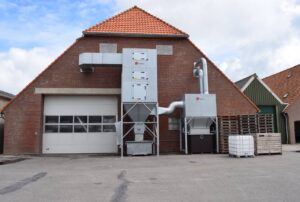
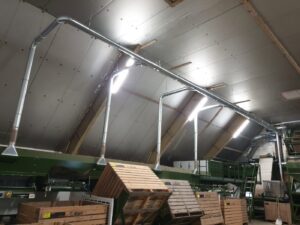
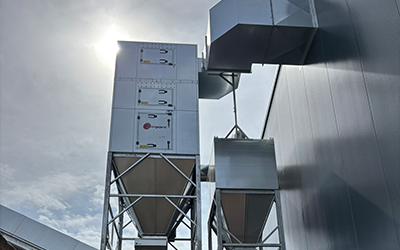
Jongejans supplied De Lugt with a complete extraction system for an optical potato sorting line. In addition to a central extraction system, dust tents were used, a lint trap was installed, and windshifting is being utilized. All extracted air is routed through the PGF unit. This consists of a whisper-quiet, high-efficiency fan and filters that are automatically cleaned with compressed air. This maintains the PGF's suction power. The filtered air is returned clean to the room, preventing heat loss. Extraction reduces particulate matter and enables the sorting line to operate. Without extraction, the dust will prevent a clear image of defects, making optical sorting impossible.