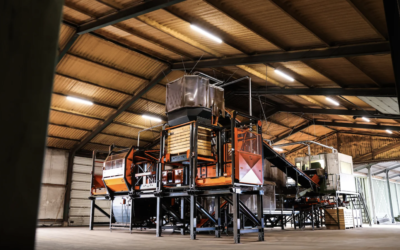

Fine dust kept to a minimum during potato processing
Fine dust is extracted from nineteen drop points in the sorting, packaging, and weighing line at Aardappelhandel Mol BV's new location in Westmaas. From infeed to bagging, specialist Jongejans Luchttechniek has provided a solution for areas where dust can easily spread. This primarily creates a pleasant working environment and, according to owner Marco Mol, is therefore worth every euro invested. "The consequences of a mist curtain and dust constantly being displaced by all the movements in a hall cannot be underestimated."
Wherever dust spreads, it is extracted
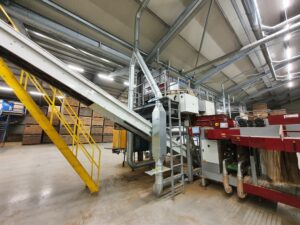
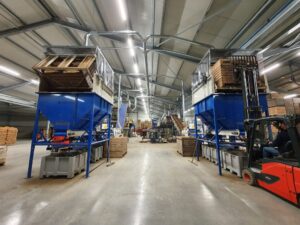
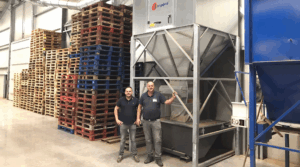
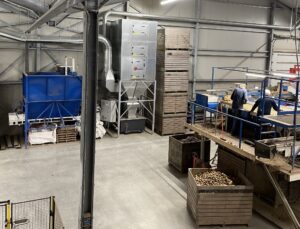
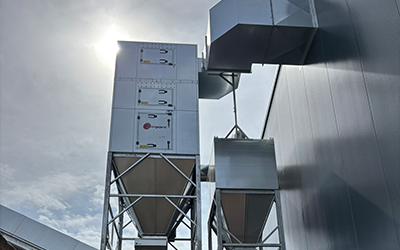
The processing hall at Aardappelhandel Mol BV remains spotless even after two and a half years and forty thousand tons of processed potatoes. The indoor climate reveals nothing of the fact that the maximum capacity for processing potatoes is fifty tons per hour and six hundred tons per day, based on 25-kilogram bags. Jongejans Luchttechniek installed a compressed air filter (PGF) specifically for particulate matter for the Westmaas-based processor. This PGF500 is equipped with filter cartridges, ensuring that the return air is returned to the room cleanly. The system is equipped with a high-efficiency fan that is both statically and dynamically balanced.
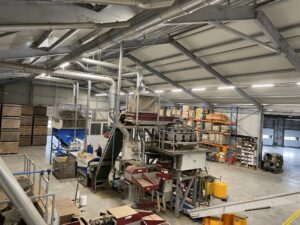
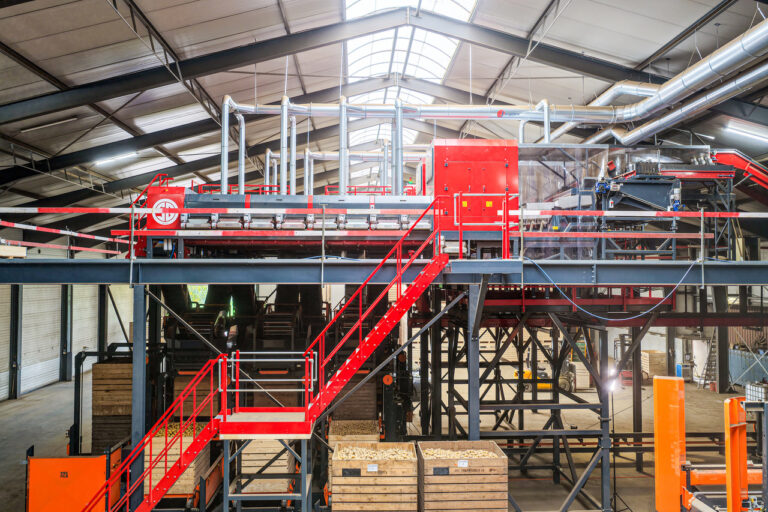
Bottom dischargers, vibrating screens, tippers, brush machines, baggers, and weighing equipment are places where dust is spread. Dust tents are placed at these locations along the line, with an extraction point above them. A negative pressure is created inside the tent, which prevents dust from spreading further and allows for more effective extraction of the polluted air.
A lint trap with slotted tubes is connected to the bagger. The tubes trap dust and burlap. The lint trap removes the burlap from the air, preventing it from reaching the filter. The system is equipped with an automatic cleaning program for the filter cartridges. This is done by using pulses of compressed air inside the cartridges. These essentially knock the coarse dirt off the filters, which then fall down into the waste collector.
Doubling of turnover volume
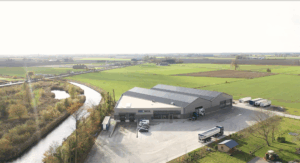
Two years ago, Aardappelhandel Mol moved from Puttershoek to its new location in Westmaas. A location that's three times as large. "We've grown along with our customers' demands. We source our potatoes primarily from growers in the Hoeksche Waard region and surrounding areas and transport them throughout the Netherlands using our own transport." Since the move, sales volume has almost doubled. "Our old location was on the edge of Puttershoek, where expansion was difficult. After searching, we decided to build a new one at this location in Westmaas."
Marco Mol explains that Jongejans Luchttechniek was deliberately asked to provide a complete solution. Ultimately, dust is now extracted at nineteen locations. "You can't do dust dispersal by halves." The DT-Dijkstra sorting system and the Eqraft processing line are equipped with an extraction system. "Effectively, we now prevent potatoes from being a source of dust dispersal throughout the entire process, from infeed to bagging."
Extraction done right in one go
Marco Mol explains that Jongejans Luchttechniek was deliberately asked to provide a complete solution. Ultimately, dust is now extracted at nineteen locations. "You can't do dust dispersal by halves." The DT-Dijkstra sorting system and the Eqraft processing line are equipped with an extraction system. "Effectively, we now prevent potatoes from being a source of dust dispersal throughout the entire process, from infeed to bagging."
Mol is satisfied with Jongejans's approach. "From the moment we start measuring and drawing, you can tell we're dealing with the absolute specialists in air technology," he says. The results are impressive. "You notice the air is changed three times an hour. In a space where produce is processed, the air is often stuffy. You could see dust particles floating through the air. In many places, you'd see a layer of dust. This is then displaced by forklift movements. With dust problems, you're easily caught in a visual loop. That was also the case at our old location. You want to prevent that for yourself and your staff. You don't want working conditions to cause people to develop lung problems, for example."
A healthier workplace
The extraction system is frequency-controlled. When the packaging or sorting line is switched on, the air in that section is extracted. "We don't have to worry about it. All we have to do is empty the tipping bin every week and a half to two weeks. Just imagine how much dust is extracted then."
The reactions have been nothing but positive, although the Mol family was the only one previously affected by the dust curtain. "The fog is gone now. It's much cleaner. You notice that immediately. The workplace is now much healthier and more pleasant."